

How Is Mad Honey Made?
Mad honey is made when giant Himalayan bees collect nectar from specific high-altitude rhododendron flowers rich in grayanotoxins. Harvested from cliffside hives above 8,000 feet, its potency depends on altitude, bloom timing, and raw handling.
Most people buying mad honey run into two problems. Finding authentic mad honey is difficult, and using raw mad honey correctly can be confusing.
Many products labeled “mad honey” are sourced from the wrong regions, blended with other honey, or processed in ways that weaken the active compounds. Even when you manage to find the real thing, raw mad honey can still be inconsistent, difficult to dose, and inconvenient to use.
Here are the factors that actually determine whether mad honey works:
-
The flower source: Only certain Himalayan rhododendron species contain the grayanotoxins responsible for mad honey’s effects.
-
Altitude: Above roughly 8,000 feet, nectar sources narrow and grayanotoxin concentrations increase.
-
Bee species: Authentic mad honey is produced by Apis laboriosa, the giant Himalayan cliff bee.
-
Harvest conditions: Traditional cliff harvesting preserves the original nectar source without dilution.
- Raw handling: Heat, blending, or excessive processing can weaken the active compounds.
Even when everything is sourced correctly, raw mad honey still has a practical challenge. Dose and usability.
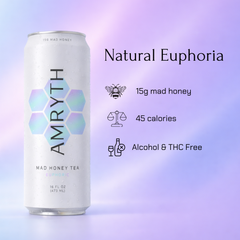
That’s where Amryth’s Mad Honey Tea comes in.
Crafted with authentic Himalayan mad honey, Amryth turns this rare ingredient into something simple and easy to share.
If you want to understand why real mad honey feels different, you have to trace it back to the beginning: The flower.
It Starts With a Specific Flower
Mad honey’s effects come from where bees land.
Certain rhododendron species produce naturally occurring compounds called grayanotoxins. These compounds are present in the nectar. When bees collect that nectar, the grayanotoxins travel with it straight into the honey.
But here’s where it gets interesting:
Not All Rhododendrons Make Mad Honey
There are dozens of rhododendron species across the Himalayas. Most produce little to no grayanotoxins. Only select species, growing in very specific ecological conditions produce nectar concentrated enough to create psychoactive honey.
Why Altitude Changes the Chemistry
People love to say “Himalayan mad honey” like it’s a vibe.
Altitude is a biochemical filter. Above roughly 8,000 feet:
- Grayanotoxin-rich rhododendrons grow densely
- Competing nectar sources thin out
- Giant Himalayan bees dominate the region
Below that elevation floral diversity increases. Nectar sources mix. Potency dilutes.
At high altitude, bees forage in a tight botanical ecosystem. At lower elevations, nectar gets blended across plant types. That blending dramatically reduces grayanotoxin concentration.
The Bees: Why Only One Species Really Matters
You can’t mass-produce authentic mad honey with commercial bees.
It just doesn’t work.
True Himalayan mad honey is produced by Apis laboriosa, the largest honeybee species on Earth.
Here’s what sets them apart:
- Up to 3 cm long
- Adapted to high-altitude environments
- Nest on exposed cliff faces
- Forage in narrow mountain ecosystems
Commercial honeybees (Apis mellifera) operate in managed hives, at lower elevations, collecting nectar from dozens of plant sources daily.
That diversification is great for grocery store honey, but not for mad honey.
Apis laboriosa forage within high-altitude rhododendron zones. That concentrated botanical access is what allows grayanotoxin levels to remain intact.
Cliff Hives: Where the Honey Actually Forms
Imagine standing at the base of a Himalayan cliff.
Look up.
Hundreds of feet above you, a single golden comb clings to bare rock. No wooden boxes. No frames. No protective sheds.
Just bees and gravity.
Apis laboriosa build single-comb hives on exposed vertical cliff faces. These locations are not aesthetic choices. They’re ecological necessities. Rhododendron density is highest along these rugged slopes.
This isolation prevents nectar mixing. It concentrates the source. Which means the honey forming inside that comb reflects exactly what those bees consumed.
Harvesting: Rope Ladders, Smoke, and Timing
Getting the honey out is not simple.
Traditional Himalayan honey hunters descend cliffs using handmade rope ladders. Fires are lit below to gently smoke bees away from the comb. Harvests typically happen twice per year in spring and autumn.
Spring matters most.
During peak rhododendron bloom, nectar concentration is at its highest. Spring-harvested mad honey tends to carry stronger grayanotoxin levels.
Autumn harvests can be more variable as flowering cycles shift and nectar diversity increases.
Why Most “Mad Honey” Doesn’t Work
1. Dilution Through Blending
Large-scale operations often mix honey from multiple regions. Grayanotoxin concentration spreads thin.
2. Lower Elevation Sourcing
Below 8,000 feet, nectar sources diversify and potency drops fast.
3. Managed Hive Claims
Apis laboriosa are not domesticated. If someone claims “cultivated Himalayan mad honey,” it’s probably heavily diluted.
4. Heat Processing
Grayanotoxins degrade under heat and prolonged light exposure. Pasteurized honey loses strength. Authentic mad honey is:
- Wild-harvested
- High-altitude sourced
- Single-region collected
- Raw and minimally handled
Anything else is usually watered down.
From Hive to Jar: Protecting the Active Compounds
Once harvested, handling matters.
Grayanotoxins are sensitive. Excessive heat and light can degrade them. Raw processing preserves potency. That’s why true mad honey is:
- Unfiltered or lightly strained
- Unpasteurized
- Stored away from light
- Not aggressively processed
It’s closer to what left the comb. The more it resembles a supermarket squeeze bottle, the less likely it resembles authentic mad honey.
Nepal and Turkey: The Two Primary Regions

Mad honey historically comes from two areas:
- The Himalayan regions of Nepal
- The Black Sea region of Turkey
Both produce grayanotoxin-rich honey from rhododendron species native to their ecosystems. But the Himalayan product harvested from high cliff hives above 8,000 feet is often considered the most potent due to the ecological isolation and density of forage zones.
Why Potency Varies (And Why That’s Normal)
Here’s the part no one talks about clearly: Mad honey potency is not uniform. It depends on:
- Bloom timing
- Elevation
- Weather patterns
- Flower maturity
- Foraging density
Even within a single comb, concentration can vary. That’s why responsible use always starts small, and authentic sourcing matters.
What This Means for You
When you understand how mad honey is made, you start asking better questions:
- What altitude was this harvested at?
- Which bee species produced it?
- Was it heat processed?
- Is it blended?
If the seller can’t answer those, don’t waste your time.
Ready to Experience Properly Sourced Mad Honey?

Product Featured: Amryth’s Mad Honey Tea
If you’ve tried “mad honey” before and felt nothing, there’s a good chance you never had the real thing. We work directly with Himalayan cliff harvesters above 8,000 feet, sourcing wild Apis laboriosa honey and transforming it into a euphoric drink you can share with your friends.
Explore Amryth Mad Honey Tea and feel what properly sourced Himalayan mad honey is supposed to feel like.