

What Is In Mad Honey? Origins, Effects & Truth
Mad honey contains natural sugars, enzymes, pollen, and trace minerals found in raw honey, plus grayanotoxins from high-altitude rhododendron nectar. These compounds interact with sodium channels in the nervous system, creating its signature warm, body-centered effects.
You’ve probably seen mad honey mentioned somewhere. A podcast clip. A late-night scroll. A friend saying there’s a honey that actually changes how you feel.
But what ends up inside mad honey is not random. Its composition depends on a few specific factors tied to the mountain ecosystems where it is produced.
The most important ones are:
-
Plant source: Mad honey comes from nectar collected from specific rhododendron species that contain naturally occurring grayanotoxins.
-
Altitude: These plants grow densely at high elevations where fewer competing flowers dilute the nectar.
-
Bee species: In the Himalayas, giant honey bees forage within these isolated mountain ecosystems.
-
Harvest environment: Cliffside hives and remote forage zones keep the nectar source concentrated.
- Raw composition: Like other raw honeys, mad honey still contains natural sugars, enzymes, pollen, and trace minerals from the surrounding landscape.
Understanding these factors explains why authentic mad honey can be difficult to source and even harder to use consistently.
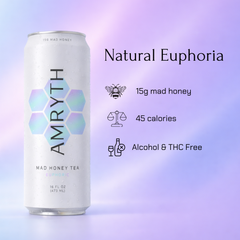
That’s why we created Amryth’s Mad Honey Tea.
It starts with authentic Himalayan mad honey and turns it into something far easier to enjoy. Instead of measuring sticky spoonfuls, each can contains a consistent amount so the experience stays clean and fun to share.
At the center of that experience is one compound: grayanotoxins.
Keep reading to see where those compounds come from and how Himalayan mountain ecosystems shape what ends up inside mad honey.
The Origin: High-Altitude Rhododendrons
Mad honey contains grayanotoxins because of one specific plant source: high-altitude rhododendrons.
Certain rhododendron species grow in dense clusters above roughly 8,000 feet. At those elevations, the flowers produce nectar rich in grayanotoxins, a group of naturally occurring diterpenes. These compounds exist in the plant’s leaves, stems, and nectar as part of its survival chemistry.
When bees forage on these blooms, the nectar carries grayanotoxins back to the hive. During the transformation from nectar to honey, the compounds remain chemically stable. The finished honey reflects the plant chemistry of the region where it was gathered.
Altitude shapes concentration. At lower elevations, bees forage across a wider range of flowers, which dilutes botanical specificity. At higher elevations, rhododendron stands dominate the landscape. That botanical concentration drives potency.
Nepal’s Himalayan valleys and Turkey’s Black Sea region provide the most recognized environments where these conditions align. In both regions, elevation and flower density create consistent grayanotoxin presence in the nectar.
Mad honey contains the chemistry of the mountain it comes from.
The Bees: Apis laboriosa
In the Himalayas, mad honey is closely associated with Apis laboriosa, the Giant Himalayan honey bee. This species lives at extreme elevations and builds large, single-comb hives directly onto exposed cliff faces.
Their habitat overlaps precisely with high-altitude rhododendron zones. That overlap ensures a concentrated nectar source during bloom season. The honey reflects the ecosystem surrounding the hive.
When bees forage within isolated rhododendron regions, the nectar remains botanically focused. That focus preserves grayanotoxin concentration in the final honey.
Bee species, elevation, and flower density operate together. Each factor influences what ends up inside the jar.
The Active Compound: Grayanotoxins
Mad honey contains one defining bioactive compound: grayanotoxins.
Grayanotoxins are naturally occurring diterpenes found in certain high-altitude rhododendron species. When bees collect nectar from these flowers, the compounds remain chemically stable during the conversion from nectar to honey.
These compounds are what give mad honey its distinctive character. In the right concentration, they create the warm, euphoric sensation that has made mad honey sought after for centuries.
What Else Is In Mad Honey?
Beyond grayanotoxins, mad honey contains the same core components found in raw honey:
- Fructose and glucose (natural sugars)
- Enzymes such as invertase and glucose oxidase
- Pollen particles from rhododendron flowers
- Trace minerals and antioxidants
The difference lies in the botanical source. When nectar comes predominantly from high-altitude rhododendrons, the pollen and nectar profile reflect that ecosystem.
Mad honey contains concentrated plant chemistry shaped by altitude.
How the Compounds Translate Into Effects

Product Featured: Amyrth’s Mad Honey Tea
Most people begin to feel effects within 30 to 90 minutes.
The first change is physical. Warmth spreads outward. Muscles relax. Breathing deepens. As the nervous system settles into altered signaling, mood follows. The experience builds toward a steady plateau around two hours and gradually fades over four to six hours.
Why Sourcing Changes What’s Inside the Jar
The chemical composition of mad honey depends entirely on:
- Elevation
- Rhododendron species density
- Bee foraging range
- Harvest season
High-altitude zones above roughly 8,000 feet produce nectar with higher grayanotoxin concentration. When bees forage primarily within those zones, the honey reflects that chemical density.
Mixed floral environments dilute the compound. Lower elevations produce milder concentrations. Blended honey reduces consistency.
Heat, prolonged light exposure, and excessive processing can degrade sensitive plant compounds over time. Raw, minimally processed honey preserves its natural profile more effectively.
When people ask what is in mad honey, the full answer includes geography. Elevation and ecosystem define the molecular content long before the honey reaches a jar.
Experience Authentic Mad Honey

Knowing what is in mad honey makes sourcing matter.
Elevation determines grayanotoxin concentration, bee species determines nectar range, and harvest timing influences potency. These factors shape what actually ends up in the jar.
At Amryth, we source wild Himalayan mad honey from high-altitude cliff-side hives and standardize it into a measured, ready-to-drink format. Each can delivers a consistent amount, allowing you to experience natural euphoria the way it was meant to be.
Try Amryth’s Mad Honey Tea and experience an ancient tradition refined for modern nights.